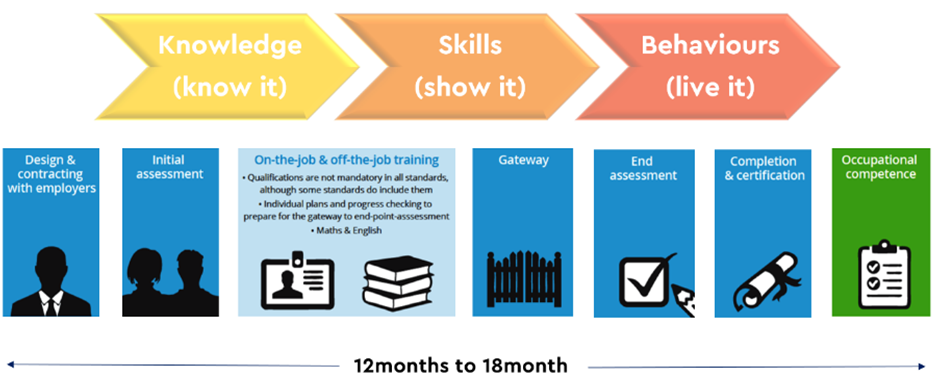
Before enrolling a member of staff (new or existing), you should appoint them a work mentor. This role isn’t necessarily about line managing and disciplinary, but coaching and passing on soft skills such as:
- Building rapport
- Team work
- Integrity
- Positivity
- Professionalism
To support you, KTA will provide you with a monthly progress tracker, quarterly reviews with tutor and learners, and mid & endpoint appraisals with an account manager to review the service, voice your feedback and understand additional progression options for current staff, new incentive schemes and recruitment solutions.
Employing someone for the first time
If you are taking on an employee for the first time and need a bit of free advice and guidance, use this 2 links to help:
- General advice around what every employer should consider when it comes to making sure the company it prepared and staff are safe to work: https://www.nidirect.gov.uk/articles/employers-health-and-safety-responsibilities
- Set-up a free chat around employment law with ACAS here: https://employersdirect.org.uk/employment-law-advice/
Rules on working hours for people under 18
If someone is 15, 16 or 17 years old, they might be legally classed as a ‘young worker’. A young worker is someone who has reached school leaving age but is under 18.
School leaving age is different in England, Scotland and Wales. Check school leaving ages on GOV.UK. The Working Time Regulations 1998 sets the legal working time limits for young workers.
Whether they’re an employee or worker can also affect their rights.
If you think an employer is not following the law, it’s best to raise the issue with the employer first.
When young people can start work
A young person can start full-time work once they’ve reached school leaving age. Before school leaving age, the work they can do is restricted and depends on their local authority.
Between their school leaving age and 18, a young person in England must do one of the following:
- full-time education or training, such as school or college
- work-based learning, such as an apprenticeship
- working or volunteering (for 20 hours or more a week) while in part-time education or training
In Scotland and Wales this law does not apply. Once a young person has reached the minimum school leaving age, they can go into full-time employment.
Working hours and rest breaks for young workers
By law, young workers must not work more than:
- 8 hours a day
- 40 hours a week
They must also have, as a minimum:
- a 30-minute break if their working day is longer than 4.5 hours
- 12 hours’ rest in any 24-hour period in which they work (for example, between one working day and the next)
- 48 hours’ (2 days) rest taken together, each week or – if there is a good business reason why this is not possible – at least 36 hours’ rest, with the remaining 12 hours taken as soon as possible afterwards Find out more about making up for missed rest breaks
Pay for young workers
Anyone employed and above school leaving age must get paid at least the National Minimum Wage.
Discrimination
Age is a protected characteristic by law under the Equality Act 2010. This means it’s against the law to treat someone less favourably because of either:
- their age
- the age they appear to be
Find out more about age discrimination