
The Autumn Budget signals a clear shift in how apprenticeships and employer​

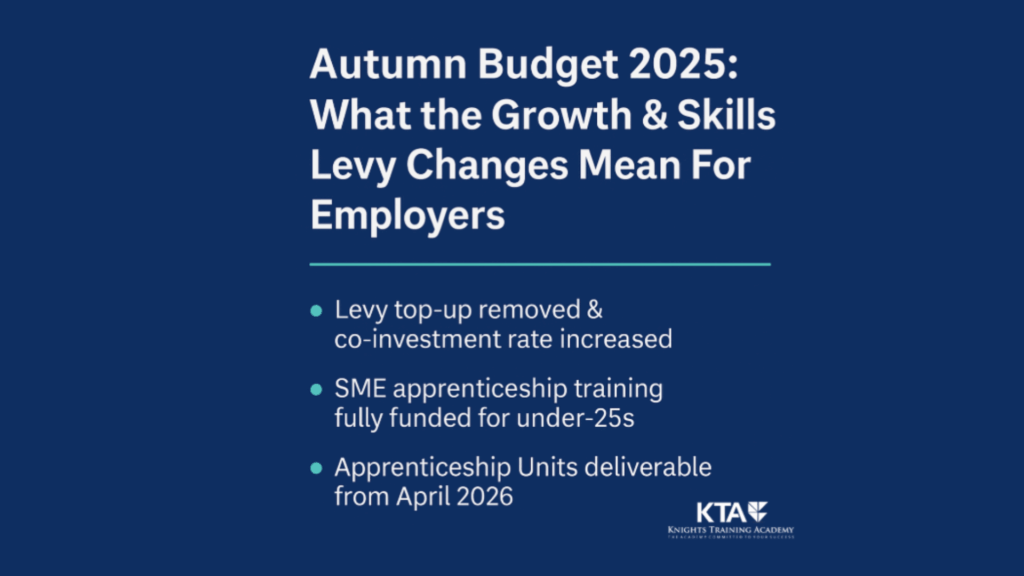
The Autumn Budget signals a clear shift in how apprenticeships and employer-funded skills will operate. For levy-paying employers, significant reforms are set to begin from 2026, reshaping how levy funds can be distributed and used. While some implementation details are still being finalised, the intent is clear: more flexibility and faster deployment of skills through the introduction of “Apprenticeship Units.” 

Here’s what’s changing, why it matters, and how employers can prepare. 

Levy Funding – Three Important Changes 
  • Levy top-up removed
  • The 10% government uplift previously added to levy accounts will no longer apply.
  • Expiry window halved
  • Employers will now have 12 months to utilise incoming levy funds (previously 24 months).
  • New co-investment levels once levy pot is empty
  • After levy funds are used, the government will cover 75% of remaining costs (currently 95%).
  • The employer contribution rises to 25% (currently 5%). 

What it means 

Levy-paying employers will need stronger workforce planning and earlier visibility of expiry dates. Investment will likely shift toward programmes that prove measurable impact quickly. 

What it means 

SMEs can now recruit or upskill younger employees with zero training cost. For levy-paying organisations, this signals a stronger government focus on early careers and workforce entry routes. 

New Opportunity from April 2026: Apprenticeship Units 

The introduction of modular Apprenticeship Units will allow levy funds to be spent on short, targeted training rather than full 12–18 month apprenticeships. 

These units will be extracted from existing apprenticeship standards and initially focus on high-demand skills areas such as digital, engineering, and AI.

Can KTA offer units from our own standards? 

Current standards delivered by KTA include:


We expect that units may become available from these standards, but we are awaiting final guidance from the Institute for Apprenticeships & Technical Education (IfATE). Once confirmed, there could be an opportunity to deliver individual components from each apprenticeship for rapid workforce development. 

What it means 

Levy-paying employers will soon be able to access fast, focused training for existing staff without committing to a full apprenticeship. This is ideal for addressing knowledge gaps or supporting digital adoption in a time-efficient way. 

How Employers Can Prepare Now 

  •  Audit levy balance and expiry dates – a 12-month window means earlier planning is essential 
  • Prioritise pathways with strong skill outcomes that can transition into modular delivery in 2026 
    Engage with providers who understand your workforce needs and can align content to standards 
  • Brief line managers – expect shorter, more frequent training interventions as units go live 

Where KTA Can Support 

Knights Training Academy already delivers marketing and digital apprenticeship programmes aligned to national standards. As the Growth & Skills Levy moves toward modular delivery, we aim to support employers by helping to: 
  • Identify priority skills in marketing, digital content and customer engagement 
  • Map existing roles to apprenticeship standards or future unit-based delivery
  • Shape levy strategies to ensure funding is fully utilised before expiry
  • Support employer workforce plans ahead of the 2026 changes
The Budget is a clear signal: levy utilisation must be strategic, measurable and future-facing. Employers who act now and focus on fast-evolving skills will be well positioned as Apprenticeship Units launch in 2026. 


More Posts

Knights training academy blog april 2026

Apprenticeship Changes 2026: What Employers Need to Know

The Government has announced major apprenticeship reforms, backed by £900m investment over the next three years.
The direction is clear. More focus on 16–24-year-olds, key skills gaps, and making apprenticeships easier for employers to use.

Get ahead in the agent qualification journey 

Mandatory qualifications for property agents are firmly back on the agenda. Revived by the RoPA report and reinforced through ongoing Government consultation, the direction of travel is clear. The sector is moving towards higher standards, greater accountability and formal recognition of competence.

Confidence, Capability, and Career Progression Through Apprenticeship

At Knights Training Academy, we are proud to support learners working across housing and property management to develop the knowledge, confidence and practical skills needed to progress in their careers.
This month, we are pleased to share the success story of Tanya Kirk, who successfully completed her Housing & Property Management Level 3 Apprenticeship while working full time in a demanding property role.

Quarterly Update for Apprentices & Employers

This newsletter has been created to support both apprentices and employers by
sharing practical guidance, celebrating success, and showing how feedback directly
shapes the way we deliver training. It brings together learner voice, employer insight,
and governance oversight to provide a clear picture of what is working well and where
improvements have been made.

Get in touch!

We'd be happy to answer any questions you have. Simply fill out the form below.